Know Your Slugs Before You Declare War: Five Common UK Species and What They're Actually Doing
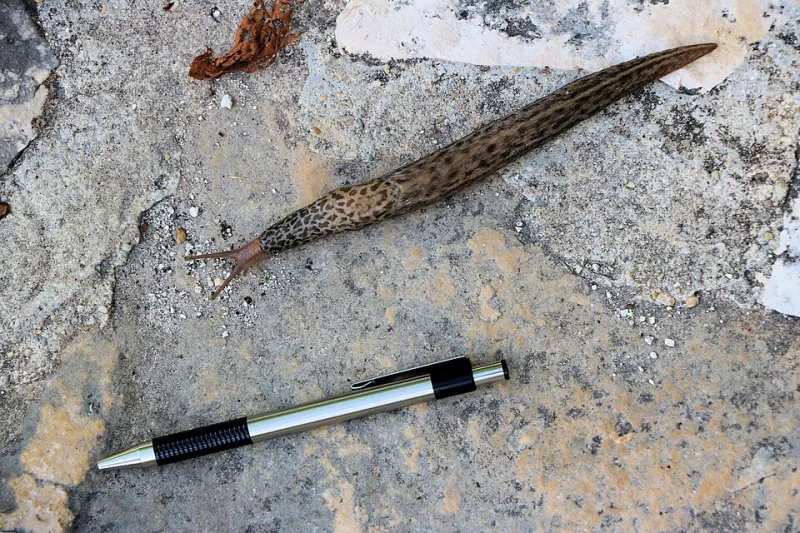
Photo: Paul Harrison, CC BY-SA 4.0, via Wikimedia Commons
There is a particular kind of gardening frustration that arrives at dusk with a torch and a vague sense of grievance. Something has shredded the lettuce. Something must pay. But before the pellets come out of the shed, it is worth asking a slightly more interesting question: which slug, exactly?
British gardens hold a good number of slug species, and the majority are not interested in your young plants. Many are decomposers, working through fallen leaves, spent foliage and kitchen-bound compost. One is an active predator of other slugs. Knowing the difference takes a couple of minutes and saves a lot of misplaced effort.
How to look at a slug
You do not need a hand lens, but you do need to look at three things. First, the mantle — the shield-like patch behind the head — and whether its pattern continues onto the rest of the body. Second, the keel: the ridge running along the back towards the tail, which may be sharp and prominent or soft and barely there. Third, the mucus, which can be clear, watery, yellow or aggressively sticky.
Size and colour help, but they can mislead. Big is not the same as harmful, and small brown slugs are the ones that do most of the damage in a British garden.
1. The leopard slug (Limax maximus): the one doing you a favour
Large, boldly blotched with dark spots on a pale grey or buff background, and often found in compost heaps, damp cellars and among rotting wood. It has a distinctive keel and, when disturbed, will sometimes curl into a tight spiral.
Leopard slugs are omnivores with a taste for other slugs and snail eggs, along with decaying vegetation. They are not innocent of the occasional nibble at a soft seedling, but they are not your enemy either. If you find one under a pot, put it back.
2. The grey field slug (Deroceras reticulatum): the usual suspect
Pale grey to beige, often with a faint netted pattern, around three to four centimetres long, with a short mantle and a soft keel towards the tail. Disturb it and it may produce a milky, sticky secretion. It is the slug most often responsible for damage to seedlings, vegetables and young border plants across the UK.
It also lives largely below the surface, feeding on seeds and emerging shoots, which is why the damage can appear before you ever see the culprit. Most of the 'slug problem' in a new bed is this species.
3. The garden slug (Arion distinctus and Arion hortensis): small, dark, persistent
These two are near-identical to the eye — dark grey to blackish, with a contrasting pale or orange underside and a yellow-orange mucus. Ten minutes with a hand lens will not settle it; they are usually recorded as a pair.
They are genuine plant feeders, partial to young growth and to plants grown in containers, and they are far more likely to be found climbing than the grey field slug. Small size makes them easy to overlook when you are scouting.
4. The large black slug (Arion ater): big, alarming, mostly harmless
The one that turns up in the kitchen doorway and causes a household incident. Adults can reach ten to fifteen centimetres, and colour varies from black through brown to a startling orange-red, with a single colour usually dominating. The mucus is colourless and the foot has a prominent fringe.
It is largely a decomposer, feeding on carrion and rotting plant matter, and is rarely a significant garden pest. It is also capable of contracting into a compact, rocking lump when threatened — a defence that makes it look considerably more menacing than it is. Relocate it and move on.
5. The yellow cellar slug (Limacus flavus): the compost-heap recycler
Greenish-yellow to olive with dark mottling, a pale keel and yellow mucus, usually found in damp, dark, food-rich places: cellars, outbuildings, compost bins and the base of a water butt. It is a detritivore, eating decaying material and algae, and it is not a threat to your borders.
It does, however, sometimes wander indoors, which is where most of its bad reputation comes from. It is a symptom of a damp corner, not a pest problem.
What this means in practice
If your damage is on seedlings, young vegetable transplants and soft new growth in containers, the odds are on the grey field slug and the garden slug — small, dark, hard to spot, and worth targeting with prevention rather than panic. If your slug is large, boldly patterned or found in compost, it is probably doing a job you would otherwise have to do yourself.
That distinction matters when you are choosing what, if anything, to buy. Physical measures — raised pots, dry surfaces, cleared debris, barriers around vulnerable seedlings, watering in the morning — address the conditions that suit plant-eating slugs without touching the recyclers. Nematodes, applied correctly to warm soil in the right conditions, are another targeted option. A broadcast bait does not make that distinction at all.
Building the habit
Keep a small notebook, or a note on your phone, and record what you find and where. Over a season, patterns emerge: which beds harbour the small dark climbers, which corners are compost-heap territory, which containers are worth protecting and which can be left alone.
That is the confidence a field guide gives you. Not a licence to wage war, but the ability to look at a slug on a damp November evening, work out what it is doing there, and decide that — this time — nothing needs to be done at all.